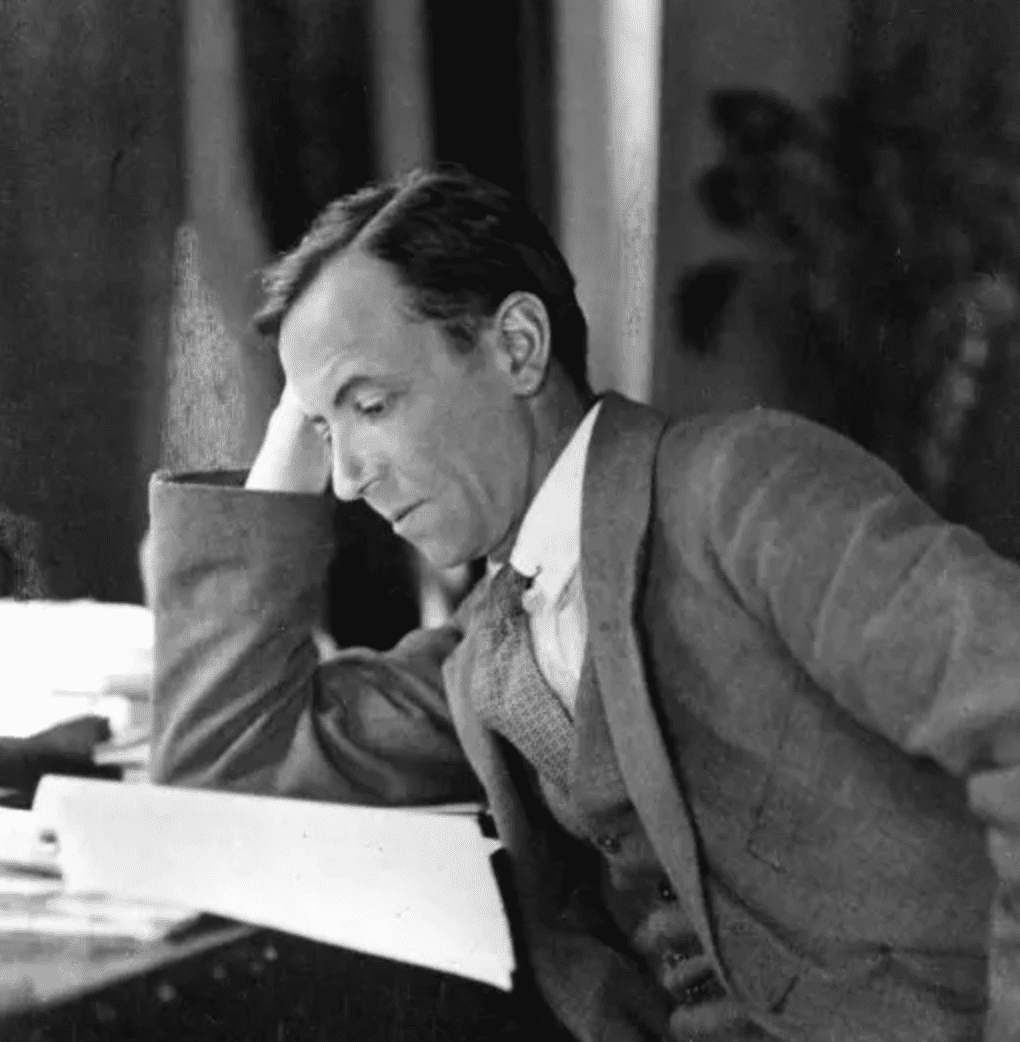

At the beginning of the 20th century, the world of physics was on the verge of monumental discoveries. Scientists conducted various painstaking studies and fervently solved the secrets of the atomic nucleus. One of them was James Chadwick, a physicist from Manchester who managed to change our understanding of the atom structure with his breakthrough discovery of the neutron. Learn more at imanchester.info.
Young years and formation
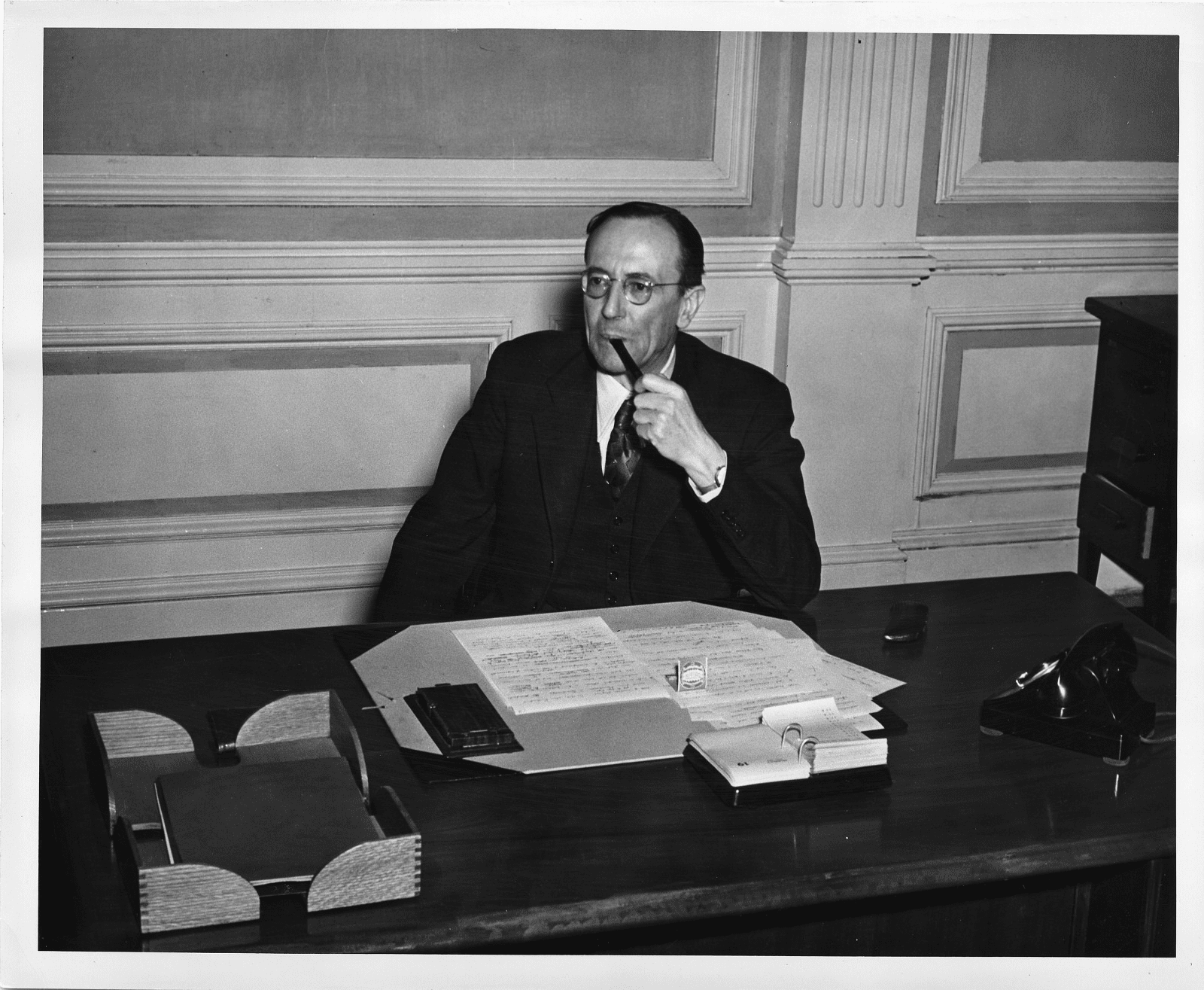
The future physicist James Chadwick was born in Bollington, a small town near Manchester, in 1891. He grew up in a rather modest family. His father was a cotton spinner and his mother was a domestic servant. When the young boy was only four years old, his parents moved to Manchester and his grandparents took responsibility for the boy’s upbringing. It should be noted that from an early age, Chadwick showed exceptional abilities in natural sciences and mathematics. He was quite successful in his studies. In particular, he attended Bollington Cross Primary School. There, his intellectual abilities brought him the first achievement in his life, a scholarship to Manchester Grammar School. But, unfortunately, the family had to refuse such an opportunity due to their financial situation. Instead, Chadwick entered the Central Grammar School for Boys, which was located in Manchester. At the age of 16, he successfully passed two exams for university scholarships and won both of them.
The future physicist chose the Victoria University of Manchester to continue his studies. It should be noted that the boy was interested in mathematics, but by mistake, he applied to the physics department. This accident turned out to be fateful and changed his entire subsequent life. Chadwick ended up in the department of the prominent physicist of the time, Ernest Rutherford. He assigned various research projects to final-year students and tasked Chadwick with developing a way to compare the amount of radioactive energy from two different sources.
At the university, Chadwick’s fascination with the atomic world grew stronger every day. Under Rutherford’s guidance, he conducted experiments that laid the foundation for his future discoveries.
Early scientific activities
Chadwick’s early university research was aimed at comparing the amount of radioactive energy from two different sources in units of activity of 1 gram (0.035 oz) of radium (this research resulted in the invention of the curie). Rutherford’s demands turned out to be unworkable and Chadwick knew it. However, as a student, he was afraid to tell his professor about it, so he continued to work and defend his point of view. Chadwick eventually succeeded in developing the necessary method. The results were included in Chadwick’s first scientific paper, which was co-authored by Rutherford.
Later, Chadwick managed to develop a method for measuring gamma radiation. As a result of this discovery, Chadwick published another high-profile scientific article.
In 1912, he graduated with honours as a Master of Science and continued his successful research and scholarly activities. Moreover, Chadwick received a special Exhibition Scholarship in 1851, which allowed him to study and conduct research at a university in continental Europe. In 1913, he decided to use all of his privileges and went to Berlin to study beta radiation under the leadership of Hans Geiger at the Physikalisch-Technische Reichsanstalt. There, he spent a lot of time on a detailed study of radiation.
However, unfortunately, the world was on the verge of the First World War. While in Germany, Chadwick was sent to the Ruhleben internment camp. Despite the brutal wartime conditions, he was allowed to continue his research there in a specially allocated stable. During the war period, he worked on the ionisation of phosphorus and the photochemical reaction of carbon monoxide and chlorine. After his release in 1918, he returned to his native Manchester, where he prepared a detailed report based on the results of his research.
In Manchester, Chadwick met again with Rutherford, who offered James a part-time teaching position. It allowed him to continue conducting research in physics. Thus, after returning to Manchester, Chadwick studied the nuclear charge of platinum, silver and copper. As a result of this research, it was found that the charge coincides with the atomic number with an error of less than 1.5%.
Discovery of the neutron
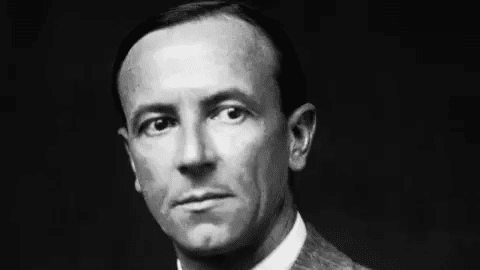
For James Chadwick, the 1920s and 1930s were a period of intense scientific research into the nature of the atom. Although protons and electrons were well-known constituent parts of the atom, the existence of another subatomic particle remained speculative. Rutherford, James’s friend and former professor, hypothesised the existence of a neutral particle inside the nucleus to explain the differences in atomic mass, but its existence had not yet been proven.
Chadwick got the opportunity to make a ground-breaking discovery in 1932. While working in the Cavendish Laboratory, he investigated the results of experiments conducted by French physicists Irène and Frédéric Joliot-Curie. They observed unusual radiation when bombarding beryllium with alpha particles. It was then that Chadwick had the brilliant idea that this radiation might not be gamma rays, as the Joliot-Curie had suggested, but something much bigger.
Through a series of meticulous experiments, Chadwick proved that the radiation consisted of uncharged particles with a mass close to that of a proton. These particles, which he called neutrons, had no electric charge and were therefore able to penetrate atomic nuclei without being repelled by the positively charged protons. It was a revolutionary discovery and a huge leap in atomic physics. James Chadwick managed to solve a part of the puzzle of the atomic nucleus in 1932.
For his revolutionary discovery of the neutron, Chadwick was awarded the Hughes Medal by the Royal Society in 1932. In addition, he also won the Nobel Prize in Physics, but years later, in 1935. He was also awarded the Copley and Franklin Medals in 1950 and 1951 for outstanding achievements in physics.
World War II and the Manhattan Project
Even before the beginning of the Second World War, James Chadwick had already become a successful figure in nuclear physics. His discovery of the neutron in 1932 introduced new possibilities for the study of the atomic nucleus. As tensions rose in Europe in 1939, Chadwick’s work gained enormous relevance, especially in the context of potential military applications. That is why the Americans tried to involve him in the Manhattan Project in every possible way.
It should be noted that having survived the First World War in isolation in Germany, Chadwick didn’t want to believe that the war would start again. But, unfortunately, the military conflict couldn’t be avoided.
When the United States entered the war in 1941, it recognised the potential benefits of a coordinated Allied effort. Therefore, in 1943, according to the Quebec Agreement, the USA and Great Britain exchanged scientific information and resources, in particular, for the implementation of the Manhattan Project.
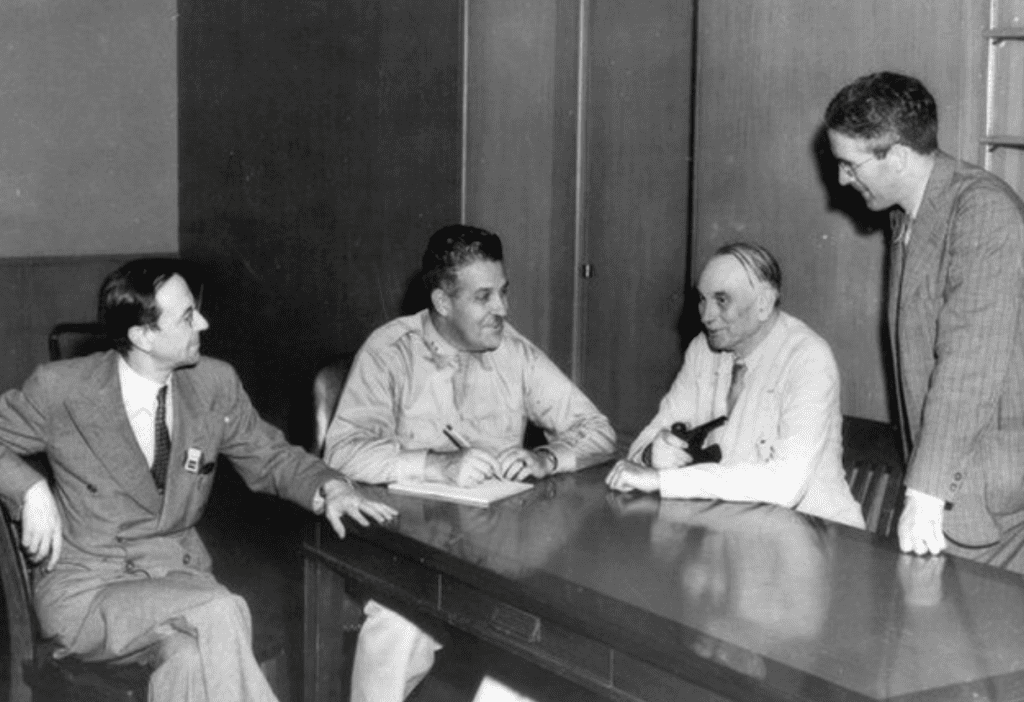
Chadwick’s experience and knowledge, which he gained over the years of work and research, were extremely valuable for the United States, especially for the implementation of the Manhattan Project. Chadwick’s role was to lead the British scientific team and participate in the theoretical and experimental work aimed at creating a successful nuclear weapon.
In 1945, the Manhattan Project reached a turning point, in particular, thanks to Chadwick’s knowledge and efforts. Then there was a successful explosion of the first atomic bomb during the Trinity nuclear test. It confirmed the theoretical and experimental basis, which was carefully developed by Chadwick and his colleagues. Soon after, the atomic bomb was dropped on Japan, marking the end of World War II.
After the end of the Second World War, Chadwick began to actively advocate for the peaceful use of nuclear technology. He was keenly aware of the destructive potential of the atomic bomb and devoted much of his later career to promoting nuclear disarmament and international scientific cooperation. He was conducting research in physics until the end of his days.
The outstanding scientist passed away in 1974, at the age of 82.