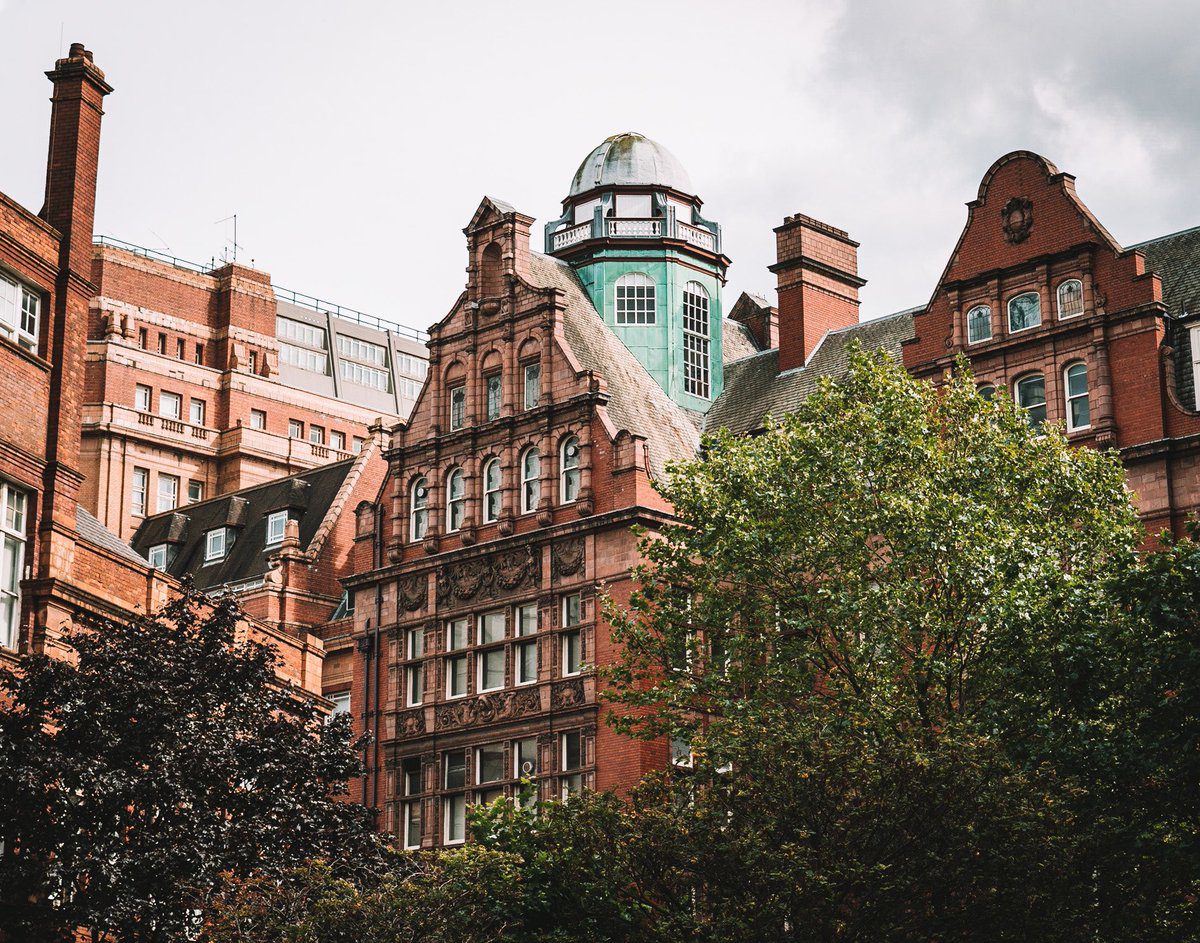

The small Godlee Observatory is located on the roof of the University of Manchester, on Sackville Street, in the very centre of Manchester. It doesn’t have a remarkable appearance, but it in no way prevented it from being the centre of astronomical research in Manchester in the 20th century. In a small octagonal room with a library, astronomers studied space using two telescopes.
The observatory, whose dome is made of papier-mâché, survived Nazi bombings during World War II and hurricanes. In addition, the Godlee Observatory played a role in the first landing of astronauts on the surface of the Moon. Learn more at imanchester.info.
Francis Godlee’s donation to the university
Astronomical observatories are scientific institutions that use astronomical instruments to observe space objects. The first observatories appeared in ancient times, since mankind has always been interested in celestial bodies.
The Godlee Observatory is located on the roof of the University of Manchester, on Sackville Street. In fact, it is the centre of the city. This small observatory was donated to the city by Manchester cotton magnate and philanthropist Francis Godlee in 1902. Obviously, this scientific institution was named in his honour.
The observatory on the roof of the University of Manchester was made of wood. Inside, it looked like an octagonal room with a library. The observation dome was led by a wrought-iron staircase of the Edwardian era, the period of the reign of King Edward VII, which lasted from 1901 to 1910.
Dome and telescopes
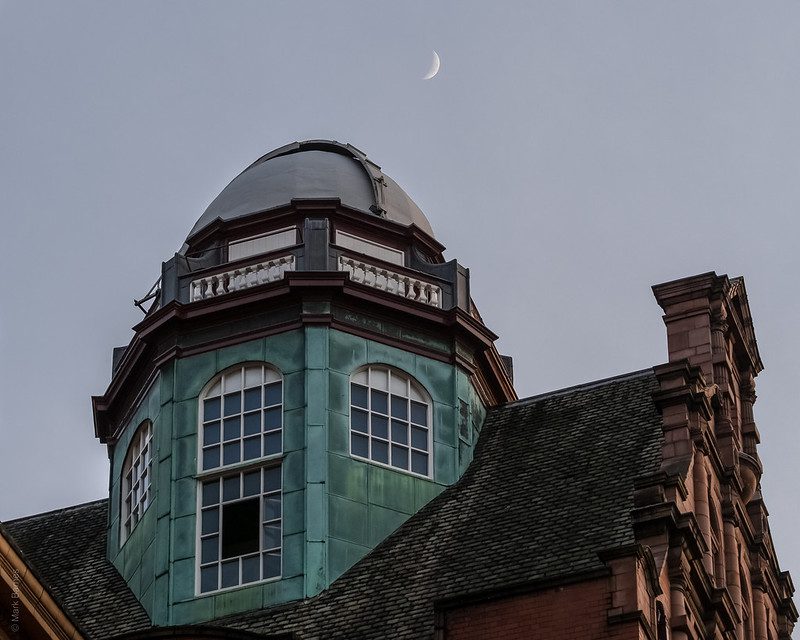
It is interesting that the dome of the observatory was made of papier-mâché. Although such material seems rather unreliable, the observatory managed to survive the Nazi airstrikes that destroyed part of Manchester as well as the rainy weather that is quite typical for the city.
In fact, a dome made of light material has become extremely convenient for astronomers. The light dome panels were easy to rotate with a wheel, thus, revealing the night sky to astronomers.
The Godlee Observatory was one of only two papier-mâché dome observatories in the UK. Another one existed until the beginning of the 21st century in the Scottish city of Dundee.
There have been two telescopes in the observatory since 1902. Both of them were manufactured by the Grubb Telescope Company, which was quite famous at the turn of the 19th and 20th centuries. It was founded by Thomas Grubb. One of the observatory’s telescopes was refracting. Its lens serves as an objective to form an image. The other one is a reflector, also known as a Newtonian telescope. Both telescopes at Godlee Observatory were installed by Thomas Grubb himself.
The Godlee Observatory was supported by the Manchester Astronomical Society. It was one of the oldest astronomical societies in England. It has always been open to anyone interested in astronomy. The society was based at the Godlee Observatory and held meetings and lectures there.
The society also took care of the appearance of the observatory. After all, as already mentioned, its dome was made of light material and could quickly deteriorate without proper care.
An important mission
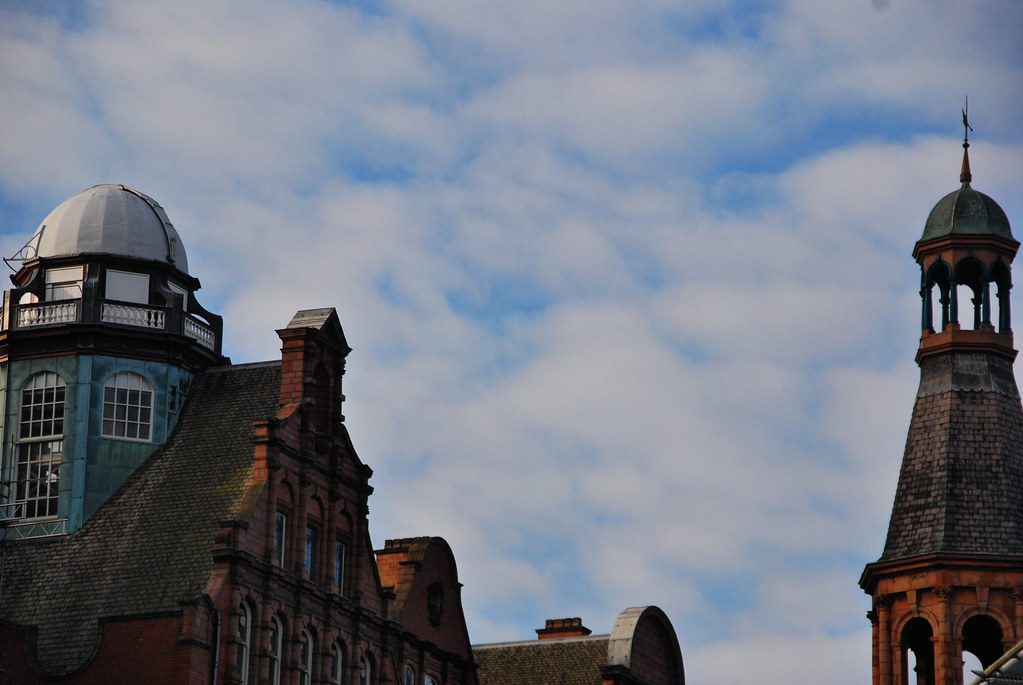
Despite being inconspicuous and modest, the Godlee Observatory contributed to an important event, the first landing of people on the surface of the Moon. It happened on July 20, 1969, when the American manned spacecraft Apollo-11 landed on the surface of the Earth’s satellite.
According to historian and member of the Manchester Astronomical Society Kevin Kilburn, during that historic mission, the Godlee Observatory astronomers observed a Moon crater called Aristarchus. They suspected that it was volcanically active. On July 19, the astronomers sent a telegram to NASA urging them to beware of Aristarchus. The NASA agency, in turn, passed this information to the Apollo 11 crew, who were in lunar orbit at that time. The spacecraft crew confirmed that they saw a strange glow at the site of the lunar crater.
Later, “Buzz” Aldrin, one of the Apollo 11 crew members, said that NASA asked them to look at the colours in the crater. Thus, the first astronauts who landed on the Moon were warned about the Aristarchus crater thanks to researchers at the Godlee Observatory.
That’s how the Godlee Observatory in Manchester contributed to the first successful human landing on the Moon.
In November 2022, the observatory was closed indefinitely due to the renovation of the North Campus of the University of Manchester. However, the residents and visitors of Manchester eagerly awaited the opening of the inconspicuous observatory to get closer to the secrets of space.
During the restoration, everyone could take an online tour of the Godlee Observatory on the website of the Manchester Astronomical Society.